Wednesday, 15 February 2023

Inconsitencies in the Qabalistic Cross

 While looking through the book The Complete Golden Dawn System by Israel Regardie, I noticed several inconsistencies in how the Qabalistic Cross is performed.

First and foremost, in one case, "Ateh" is being vibrated, and in the second "Atoh". Also, the order in which you touch the shoulders is different.

Now, the question is, which is the correct way. Here are the highlights from the book:


Volume Three

Highlight (orange) - Page 293 · Location 4617

So in making the Qabalistic Cross on your breast it is correct to touch the Forehead and say Ateh - Thou art; the Heart - Malkuth; Right Shoulder, ve-Geburah; left shoulder ve-Gedulah, and with the fingers clasped on the breast say, Le olahm, amen!

Highlight (orange) - Page 409 · Location 6526

Take a steel dagger or knife in the right hand, face East: Touch your forehead and say Atoh (thou art).

Highlight (orange) - Page 409 · Location 6527

Touch your chest and say Malkuth (the Kingdom). Touch the right shoulder and say ve-Geburah (and the Power). Touch the left shoulder and say ve-Gedulah (and the Glory). Clasp your hands in the center of the chest and say le Olahm (forever). Hold the dagger, point upwards, in clasped hands and say Amen (so be it).

Highlight (orange) - Page 447 · Location 7112

The Qabalistic Cross This magical gesture is referred to again and again throughout the whole Golden Dawn

Highlight (orange) - Page 447 · Location 7113

system. The correct way of doing this is as follows: 1. Stand upright, facing East. Imagine you are growing very tall. So tall that your head is above the clouds, while beneath your feet the Earth seems like a small globe on which you are standing. Spend a few minutes trying to achieve this piece of visualisation. The success of the whole manouevre depends on this. 2. Intone or vibrate Atoh, while touching the forehead with the forefinger of the right hand. Imagine that above you is the White Light of Kether, from which a ray descends as you proceed with the exercise. 3. Bring the hand down from the head to the middle of the chest and intone or vibrate Malkuth. Feel that the ray of Light descends all the way to the feet, not simply to the chest which you are touching. This establishes the shaft of the cross in Light. 4. Move the hand over to the left shoulder, and vibrate ve-Gedulah. While doing this, imagine that the entire shoulder is ablaze with light ready to move over to the right side to form the cross bar of Light. 5. Move the hand over to the right shoulder,

Highlight (orange) - Page 448 · Location 7124

and vibrate ve-Geburah. This will complete the cross bar, so that the entire cross is now formulated. 6. Clasp the hands over the chest, and vibrate le-Olahm Amen. As you do this, try to become acutely aware of this gigantic cross of light formulated through your entire body, now gigantic and extending high into upper space.

Friday, 10 February 2023

Trying ChatGPT's knowledge of occultism

 I decided to quiz ChatGPT regarding its occult knowledge and I must admit, I was pleasantly surprised.


Q: Define the astral plane

The astral plane, also known as the astral realm or astral world, is a concept in many spiritual and philosophical traditions. It is often described as a non-physical plane of existence beyond the physical world, where consciousness can travel and experience things beyond the physical realm.

In some beliefs, the astral plane is seen as a place where the soul or spirit can go after death, or where individuals can go during astral projection or out-of-body experiences. It is also sometimes associated with dreams and the unconscious mind. The concept and interpretation of the astral plane can vary greatly across different cultures and belief systems.


Q: What is spiritus mundi?

Spiritus mundi is a Latin term that translates to "the spirit of the world." The concept has roots in ancient philosophy, particularly in the work of the philosopher Plotinus, and has been adapted and used in various ways by different thinkers throughout history.

In general, spiritus mundi refers to the idea that there is an underlying spiritual essence or force that pervades and animates all things in the world. This idea is often associated with the belief in a universal consciousness or collective unconscious and is seen as the source of all creativity, inspiration, and wisdom.

In some esoteric and mystical traditions, spiritus mundi is seen as a powerful and transformative force that can be accessed through spiritual practices such as meditation or contemplation. In literature and the arts, the concept of spiritus mundi has been used to express the interconnectedness of all things and the idea that everything in the world is part of a larger spiritual whole.


Q: What's the relationship between the Qabalistic tree of life and the signs of the zodiac?

The Tree of Life is a central concept in the mystical system of Qabala, also known as Kabbalah, which is an aspect of Jewish mysticism. The Tree of Life is a diagram that consists of ten interconnected spheres, or Sephiroth, which represent different aspects of the divine and the universe.

The relationship between the Tree of Life and the zodiac lies in the correspondence between the Sephiroth and the signs of the zodiac. In Qabala, each Sephira is associated with a set of astrological correspondences, including a particular zodiac sign.

For example, the Sephira known as Tiphareth is associated with the zodiac sign of Leo and is said to represent the sun and the idea of balance and harmony. Similarly, the Sephira known as Chokmah is associated with the sign of Aries and is said to represent the idea of wisdom and creativity.

In Qabala, the relationship between the Tree of Life and the zodiac is seen as a way to understand the interconnectedness of all things and how the movements of the stars and planets impact the spiritual and material realms. By exploring these correspondences, Qabalists aims to gain deeper insights into the nature of the universe and their own spiritual path.


Q: Explain the Chaldean sequence of planets

The Chaldean sequence of planets, also known as the Chaldean order of the planets, is an ancient system of astrology that was developed by the Chaldeans, a civilization that lived in Mesopotamia thousands of years ago. In this system, the planets are arranged in a specific order based on their perceived distance from the Earth and their astrological influence.

The Chaldean sequence of planets is as follows:

  1. Saturn
  2. Jupiter
  3. Mars
  4. Sun
  5. Venus
  6. Mercury
  7. Moon

This ordering of the planets was considered to be of great significance in Chaldean astrology, as it was believed to reflect the relative strengths and influences of the different celestial bodies. Each planet was thought to have its own unique qualities and to influence the world and human lives in different ways, with the closest and most influential planets listed first in the Chaldean sequence.

It is important to note that this system of planetary order is specific to Chaldean astrology and may differ from other astrological traditions, such as Western astrology. However, the Chaldean sequence of planets continues to be studied and used by modern astrologers and those interested in the history of astrology.


Q: What is the Middle Pillar Ritual?

The Middle Pillar Ritual is a spiritual practice in the Western esoteric tradition, particularly in the field of Hermetic Qabala. The Middle Pillar is a central concept in Qabala and represents the balance and harmony between the different aspects of the self and the universe.

The Middle Pillar Ritual is a meditative and visualization exercise designed to activate and balance the energies of the Middle Pillar, which is said to consist of three spheres or Sephiroth on the Qabala Tree of Life: Kether, Tiphareth, and Yesod.

The ritual typically involves visualizing these spheres in the body, as well as various symbols, colors, and divine names associated with them, and imagining streams of light flowing between them. The ritual is said to help harmonize the body, mind, and spirit and to promote spiritual growth and development.

It's worth noting that the Middle Pillar Ritual is just one aspect of Qabala and that there are many other practices and techniques within this mystical tradition. Additionally, the interpretation and specifics of the ritual may vary between different esoteric schools and practitioners.


What percentage of the population believes in occultism?

It is difficult to estimate the exact percentage of the population that believes in the occult, as this can vary greatly depending on the region, culture, and personal beliefs of individuals. Additionally, beliefs in the occult and esoteric practices are often private and may not be publicly disclosed.

However, surveys and studies have suggested that a significant portion of the population has some level of interest or belief in the occult. For example, a survey conducted in the United States found that approximately 25% of respondents reported having had some type of paranormal experience or believing in supernatural phenomena, while another study in the United Kingdom found that almost 50% of respondents believed in at least one type of paranormal activity.

It's important to note that these figures are based on self-reported data and may not accurately reflect the beliefs of the entire population. Additionally, the definition of "occult" can vary widely and can include beliefs in astrology, magic, spiritualism, and other esoteric practices, so the percentage of people who specifically believe in the occult may be lower or higher depending on the specific definition used.

Thursday, 9 February 2023

Little rant about proofreading

So, for writing articles like these, I use Grammarly, which is fine, BUT, Grammarly is not really available outside the browser (and outside the English language). Another choice is LanguageTool, which not only works in the browser but is also available as an add-on to the LibreOffice Writer.

Now, when I usually write some serious body of work, I usually write it in Markdown. Writing in Markdown can be done in Visual Studio Code, where an unofficial extension exists that also uses the LanguageTool. From there, I can obviously use something like pandoc and turn my work into a book with pretty nice typesetting by default. However, the settings of the extension are pretty limited.

You see, LanguageTool allows you to set and keep a certain tone in your writing, it allows great consistency and can rephrase entire sentences to fit that tone. The extension doesn't allow that. Of course, I could simply write the entire book in LibreOffice again, but there is a catch. While LibreOffice is not bad for writing, it is awful for keeping care of citations I would normally use BibTeX for, and most importantly, the typesetting there is absolutely dreadful. You see, it takes a lot of tweaking in LibreOffice to get to the typesetting that is the default for TeX.

Another thing is, I know how the LibreOffice add-on works, it sends the paragraphs to the cloud for checking, making sure you do not pass the 10,000 character limit for the check, does the VSCODE extension do the same? It would be awful to find 10,000 characters in that the automatic proofreading doesn't work anymore.

I could of course write in LibreOffice and then copy/paste it to the Markdown, right? But then I would have to go through it all again, making marks for headlines, notes, quotes, converting citations, etc. Not sure I want to spend so much time doing that.

Sunday, 5 February 2023

Stepping out of my comfort zone

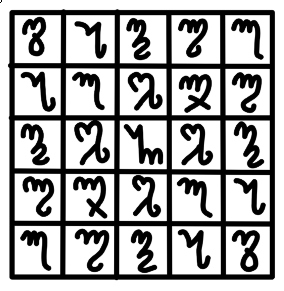
 So, after over a decade of avoiding this, I have finally decided to learn the Theban alphabet. I never liked that all the letters look so similar to one another. But look, I did learn the alphabet of the magi, I did learn the Armanen runes, I did learn the Enochian alphabet and I did partially learn Hebrew.

So, it took me 3 bloody days, but I am finally there. I must admit, the Theban alphabet does look beautiful. Here is a SATOR square as an example:


Sunday, 29 January 2023

Eighteen

 Had an interesting dream last night regarding the number 18, probably thanks to the trataka meditation over the Sigillum Dei.


This is what I found out about number 18:


  • The Hebrew word for life (chai) has a numeric value of 18
  • Shemoneh Esrei is a type of prayer (the name means eighteen)
  • 18 is a heptagonal number. Heptagonal numbers are numbers that are constructed by combining heptagons with ascending sizes.

Regarding the heptagonal number, if we take the following formula:

if we replace n with the number 3, we will get (5*3^2 - 3*3)/2, which is 18. Which means 18 is the third heptagonal number. A bit more interesting when we consider that Sigillum Dei commonly contains 3 heptagons.

Anyway, I need to delve deeper into the Shemoneh Esrei, I checked the first part of the prayer so far and it does seem interesting.

Saturday, 28 January 2023

Progress with trataka

Yesterday I had my first awaited success with the trataka meditation. I could recall the Antahkarana symbol in the vision, but it didn't have the usual afterimage color this time. Instead, it had the sort of indigo color that is normal for my mind's eye.

I also created another printable symbol that can be used for the trataka, the Sigillum Dei, the Seal of God.


My variation of the Sigillum Dei is available here: https://drive.google.com/file/d/1emmRmschlCZSgAJRjy82JWF3dDPcVmT5/view?usp=sharing

Monday, 23 January 2023

Reconstruction of the Sol square

I have reached a dead end while trying to reconstruct the Magick square for Sun (Sol). And help would be greatly appreciated. I have reached a place where I know how to construct the traditional square, but I do not know why it was made this way.


You can find my notes here: https://drive.google.com/file/d/1eDvovF1SLDoY1TI9A-rOBGgsYdzNgfF8/view?usp=share_link

Sunday, 22 January 2023

Imagination after the hiatus

 One thing that suffers a lot after a long hiatus from the practice is definitely the imagination. The imagination used for Magick is a bit different than the one humans typically use. You know, I could ask you to imagine your favorite place or a scene from a movie. You wouldn't have a problem with that. However, that kind of imagination always feels like it exists somewhere else. The imagination used for Magick exists right before you, right before your eyes, or around your body. That's why the word visualization is often used to explain the concept a bit more correctly. What is also interesting, if you focus on the properly visualized image for long enough, this image will actually burn into your retina and cause an afterimage.


So, how to develop and strengthen this type of imagination? The best method I have found so far is the trataka meditation. Trataka is great for a couple of reasons. First and foremost, it's a focal meditation, allowing you to learn how to tame your thoughts. Secondly, it's fun. For example, even 5 minutes of void meditation can feel like an eternity when you start, trataka keeps being interesting and even 20 minutes feel like nothing.


Of course, you can use many images for trataka, you can even go the path of tattvas, as it was designed by the Golden Dawn, but my favorite is probably the symbol of Antahkarana, the ever-changing symbol. Since my way of doing things changed so much during the hiatus, I do not draw by hand anymore, so I have crafted a printable version because trataka via the computer display can strain your eyes a lot. Try it out yourself and let me know.


https://drive.google.com/file/d/1kes1NFct21pHPClURgi80AugvklcOAdH/view?usp=share_link

Wednesday, 11 January 2023

Studying geomancy

 I am currently in the process of a deeper study into geomancy. I find it interesting that its houses chart is actually more complex than the one I learned for the tarot, it's more similar to the one from astrology.

For now, I can share with you the shield chart I have made in Krita.

P.S. Let me know if you want some tutorial on how to use Krita effectively in the future.

Wednesday, 4 January 2023

Generating geomantic figures with Micro:bit

 So, I did talk about geomancy before and how many different ways there are to generate the figures, so let's look at the modern one. BBC Micro:bit is a pocket-sized computer that is perfect for getting introduced into hardware programming. You simply buy the little bugger, connect it to your computer, and then go to https://makecode.microbit.org/, there you can go through the tutorials, make your code, and download it to the Micro:bit.  There are also a ton of prepared projects for you including automated plant watering, making RC models, etc.

But enough with the unpaid advertisement for the little bugger. You can also use it to generate geomantic figures. Here's what the use-case look like:


Not bad, right? This loud noise detection is a functionality of Micro:bit V2, if you got the first version, you can use either the buttons or you can code the Micro:bit to detect shaking, etc.


And this is what the code looks like in JavaScript:

// Figure is the set of four numbers
let figure: number[] = []
let partValue = 0

// Displays the generated figure
function displayFigure (figure: number[]) {
    basic.showLeds(`
        . . . . .
        . . . . .
        . . . . .
        . . . . .
        . . . . .
        `)
    for (let i = 0; i <= 3; i++) {
        displayLine(i, figure[i])
    }
}

// Generates the figure, meaning the four numbers, either value 1 or 2
function generateFigure () {
    figure = [
    0,
    0,
    0,
    0
    ]
    for (let part = 0; part <= 3; part++) {
        partValue = randint(1, 2)
        figure[part] = partValue
    }
}

// If the generated number is 2, it will light up two LED diodes on the line, else it will light up only one
function displayLine (lineIndex: number, lineValue: number) {
    if (lineValue == 1) {
        led.plot(2, lineIndex)
    } else {
        led.plot(1, lineIndex)
        led.plot(3, lineIndex)
    }
}

input.onSound(DetectedSound.Loud, function () {
    generateFigure()
    displayFigure(figure)
    music.startMelody(music.builtInMelody(Melodies.BaDing), MelodyOptions.Once)
})

Tuesday, 3 January 2023

Trying to quit smoking

 So, I think you already know that I tried to quit smoking in the past... and failed. The problem was I was usually trying to quit cold turkey, using all my willpower to stop. And people always say the same thing: "First 3 days are the hardest", "First week is the hardest", "First two weeks are the hardest", or "First month is the hardest". The truth is that quitting just sucks. And every single time you relapse, your willpower takes a massive hit, making it even harder to quit next time.


So, the idea came to my mind. Instead of trying my hardest to quit and failing, let's instead use the little willpower left for something that might actually help, Magick...


I have created a sigil for quitting smoking and have been passively charging it the traditional way.


The sigil looks like this:


The mantra associated with the sigil is FERE SATAT KORI


And here is a thing, while using the sigil, I found out that I do smoke less now. As time progresses, the sigil should be charged enough for me to completely stop. I also printed out a smaller version of the sigil so I could put it into the cigarette packet. 


But most importantly, because I know that these mantras usually have their own rhythm, I have decided this time to record myself chanting the mantra and publish it online. This can be used for meditation or even being played on a loop overnight, to affect you while sleeping.


Just keep in mind, while these chants tend to be very mesmerizing, do not attempt to listen to it while driving, as it can make you sleepy.


Monday, 2 January 2023

Happy New Year

 Happy New Year, folks, I am back!


You are all wondering, what was with the long hiatus? Truth be told, my practice was severely lacking, and that was even before I stopped posting. I didn't practice for the betterment, instead, I just practiced so I can post here about it. This took several years, and I was even hurt because of it. I remember one such attempt where I tried to evoke an entity into a physical manifestation. The whole result was pretty fuzzy, an arm here or there, fading back and forth. And my first response? Sit down at the computer and start writing, completely disregarding that an entity is currently hovering around, tapping on my shoulder. So, there, I did what a stupid person would do, banishing with a clap. And a few days later? I cut myself with a hatchet while making splinters for a campfire...


As for my practice, a lot of changes happened. First of all, I abandoned the use of all ritualistic tools (no wand, no dagger, no amulets, talismans, etc). And also, no tarot. The last one is actually easy to explain. I got kids now and my tarot deck got damaged (and then lost), instead I started using geomancy, which, quite frankly, is a much better alternative. First of all, I don't need any physical deck and the figures can be generated with many different approaches. Anything from drawing lines in a notebook up to throwing chicken bones. I also found out that geomantic figures can be combined with tarot spreads and even something as generic as the Celtic cross spread can give a lot of useful insights using geomancy.


With that being said, I do not intend to fully abandon the tools, after all, there is nothing that can really replace the black mirror, but I really need some time to charge my old mirror properly.


What else? There is a lot of stuff I can share now considering the years that I shared nothing. It's also bad luck that I have lost contact with many great people, namely because my Facebook account was suspended (Facebook REALLY doesn't like when you don't use your real name, go figure...). I will try to get some of those contacts back, but frankly, many of the New Age people I spoke with are just not worth the effort.


Anyway, with that being said. Happy New Year, and look forward to more. And if you want, just reach out to me via this blog or on Studio Arcanis.

About the Summer Solstice

What is the summer solstice The summer solstice is the time of the year when the day is the longest and the night is the shortest. It’s the ...