Queting the mind
This is a part tutorial and part rant about one of the early steps of Bardon's IIH, so brace yourself.
Before we begin, let me give you two very simple methods of quieting your mind, so you can taste what it feels like to have no thoughts. "Taste" is definitely a pun for the first method.
Easy method of quieting your mind
Try this. Stick your tongue out and grab it between your index finger and thumb; now pull it out a little. Your mental chatter should disappear; isn't that cool? Well, if you are an inner-monologue type of person, that is. If your thought process is visual instead of auditory. This didn't do anything for you. The reason is that auditory thinkers do move their tongues a tiny bit while thinking. This method stiffens the tongue and makes these microscopic movements way harder. Don't worry, you will appreciate the second method a bit more.
Visual method of quieting your mind
Now relax and close your eyes. Imagine a completely empty white room. There is a white table right at the center of that room. On the table, there is a white egg holder. And inside that egg holder, there is a black egg. This method works by creating an impossible contrast. A completely white surrounding containing a completely black egg- how crazy is that?
Progressive method of attaining the no-thought
Some of you might remember my oathbreaker series, namely the article about the full meditation.
So, just a summary for those who are unaware: full meditation consists of the following steps:
- Get comfortable
- Relax your body
- Obtain an absolute focus
- Slip into a vacancy of mind
There are a couple of reasons for these. Any weird pressure, ache, or itch will destroy your focus and distract you. Being comfortable in your position is an important first step. I myself do a lot of my meditations while lying down, but find a position that's comfortable to you.
The second step is related to the first one. You relax your body to the point you don't feel it so it cannot distract you.
The third step is a bit more complex. Usually, your mind is fragmented; the human mind processes multiple ideas at the same time, all the time. You focus on a single object or a function. As an example, you might focus on a candle light (focal meditation), on your breathing (pranayama, etc), on your third eye, or you quickly travel your mind between different extremities (yoga nidra). I will talk about this more later.
As the final step, you move from the absolute focus and just let your mind mellow. If there is any thought, just accept it and move on, back into the relaxation of your brain. Many people try to force the "no thought" by holding it. It's like holding a fart in; eventually it comes out. And in case of forcibly holding your thoughts, you might pop a vein or something.
Bardon's mistake
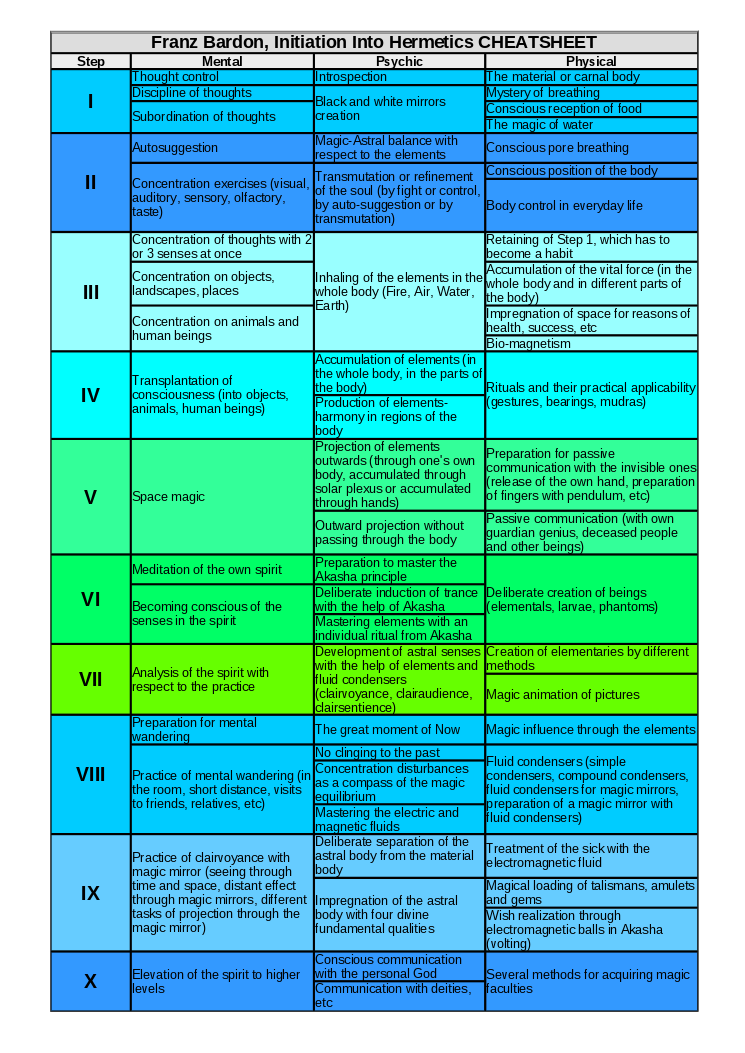
One big mistake Bardon made was to push the vacancy of mind early into the IIH without any preparation for the matter. What's worse, he actually suggested having a form of a bead counter on you, to count down the thoughts you have during your "no thoughts exercise". Does this sound familiar to you: "Oh, I had a thought, I have to count down another bead. Wait, does this count as another thought? How many beads do I have left? I wonder whether I am doing better or worse than before".
I know many people struggle with that particular exercise, but some didn't pass this step even after decades. It's insane how badly it was described in IIH and how poorly Bardon prepared the readers for this step.
The art of unified focus
So, back to step 3 of the full meditation, the absolute focus. There is no method better for this than trataka. And there is no symbol better for the trataka than antahkarana. The fun part is that trataka is generally a very useful method of meditation, especially for our kind. It calms you down, it improves your eyesight and your concentration, and it even helps develop your third eye. That's a bargain!
Comments
Post a Comment